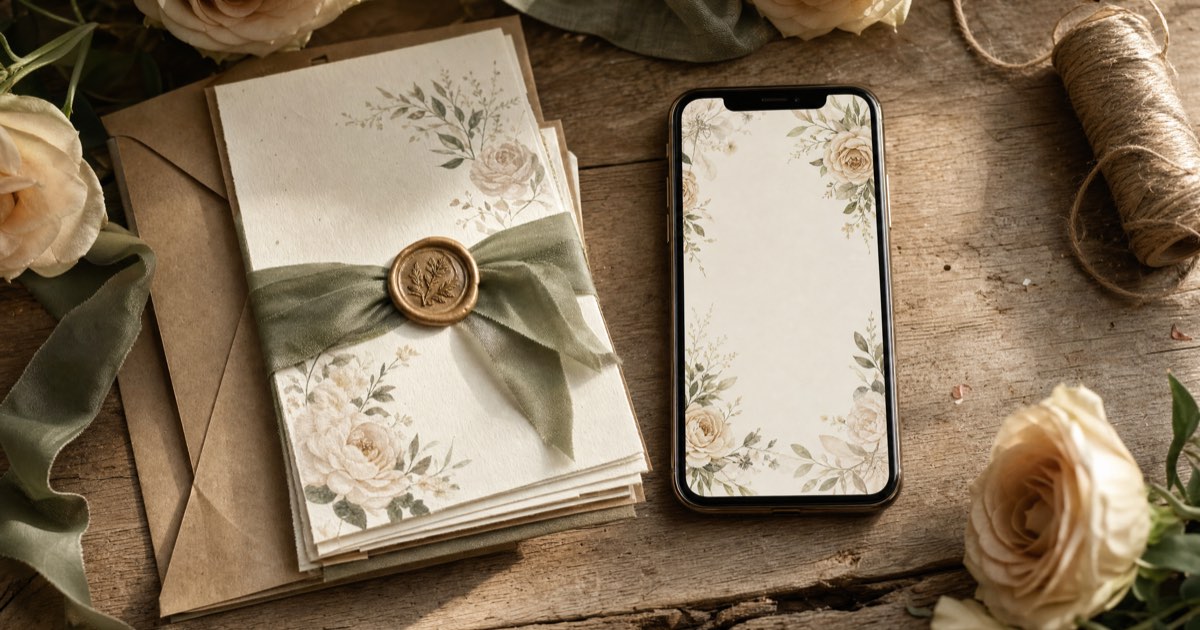
Digital vs printed wedding invitations in the Philippines: real costs for 150 guests
What 150 guests cost to invite in the Philippines, from ₱15 marketplace cards to handmade studio suites, plus delivery, design fees and the digital options, with prices checked in September 2026.
For 150 guests in the Philippines, printed invitations cost about ₱1,200 to over ₱90,000 all-in, depending on the printer, design and delivery. Digital invitations cost ₱0 to ₱8,000 for the same list. Many couples mix the two: a small printed batch for sponsors and elders, and a link for everyone else.
Every price below was checked in September 2026, on the supplier's own page wherever one exists. To see what a digital invitation looks like on a phone, open a sample invitation.
How many invitations do 150 guests need?
You don't print 150. One card goes to each couple or household, so a list of 150 people is usually 60 to 80 invitations. Planners add spares: Event Nest suggests 10 to 15 percent extra, and Bride & Breakfast says about 20 extra sets, because reprints and rush orders cost more than spares.
Every total in this guide assumes 80 printed pieces: 70 households plus 10 spares. Scale up or down from there.
How much do printed invitations cost?
Per piece, printed invitations run from ₱15 on Lazada to over ₱800 for a handmade studio suite. The spread is wide because "invitation" can mean a single glossy card or a boxed set with six inserts.
| Tier | Example (checked Sept 2026) | Per piece | 80 pieces |
|---|---|---|---|
| Marketplace, basic | 5R glossy card or card with envelope (Lazada listings) | ₱15 to ₱40 | ₱1,200 to ₱3,200 |
| Marketplace, dressed up | 3 sheets, half-sleeve envelope, wax seal, free layout (Lazada) | ₱80 | ₱6,400 |
| Print shop | Folded card with 2 to 3 inserts and envelope (Sinag Printing Press) | ₱150 to ₱200 | ₱12,000 to ₱16,000 |
| Acrylic | UV-printed acrylic card (Lazada) | ₱117 to ₱1,000 | ₱9,360 to ₱80,000 |
| Design studio, cardstock | 3-card suite, assembled, wax seal, keepsake box (Fel & Ink) | ₱10,400 for 50, then ₱170 each | ₱15,500 |
| Design studio, handmade | 6-card handmade suite (Fel & Ink) | ₱44,000 for 50, then ₱820 each | ₱68,600 |
Marketplace listings change daily, so treat those as a snapshot. The studio prices are package prices from the studio's own page.
What costs come on top of printing?
Design, envelopes and delivery. These rarely appear in the first quote.
- For layout and design, Sinag charges ₱500. Event Nest puts template design at ₱500 to ₱2,500 and custom design at ₱3,000 to ₱15,000. Fel & Ink's bespoke design fee starts at ₱20,000.
- For envelopes, Event Nest estimates ₱30 to ₱80 per envelope for calligraphy and ₱8 to ₱15 per suite for assembly.
- By courier in Metro Manila, a Lalamove motorcycle costs ₱49 to start, plus distance, plus ₱40 for every added stop. Seventy households means 69 added stops, ₱2,760 in stop fees alone, before distance, and realistically several trips.
- By post, PHLPost's official rates for registered mail up to 50 grams are ₱50 within Metro Manila, ₱85 to the Visayas and ₱100 to Mindanao, so ₱3,500 for 70 envelopes within Metro Manila and more for the provinces. A thick suite with inserts can weigh more than 50 grams, so weigh one first.
Hand delivery by family is free and, for sponsors, often expected. It also takes weekends.
What does the whole printed bill come to?
Putting the pieces together for 80 invitations, with delivery ranging from family hand delivery (₱0) to registered post within Metro Manila (₱3,500):
| Printed route | Printing | Design | Delivery (70 households) | Estimated total |
|---|---|---|---|---|
| Marketplace, basic | ₱1,200 to ₱3,200 | ₱0 to ₱500 | ₱0 to ₱3,500 | ₱1,200 to ₱7,200 |
| Print shop | ₱12,000 to ₱16,000 | ₱500 | ₱0 to ₱3,500 | ₱12,500 to ₱20,000 |
| Design studio | ₱15,500 to ₱68,600 | ₱3,000 to ₱20,000+ | ₱0 to ₱3,500 | ₱18,500 to ₱92,100+ |
These are our own sums from the published prices above, not quotes. Acrylic and dressed-up marketplace cards fall between the rows. Envelope calligraphy would add ₱2,400 to ₱6,400 for 80 envelopes.
Lead time matters as well. Sinag quotes 7 working days. Estudio Harana lists a 6-week production time. Event Nest says two to four weeks is typical, and that printed invitations should reach guests 8 to 10 weeks before the wedding. We suggest sending 10 to 12 weeks ahead, so order printing at least a month before that.
How much do digital invitations cost?
Between ₱0 and ₱8,000 for a 150-guest list at regular prices. The biggest difference between them is whether the tool records who is coming or only shows a design.
| Digital option | Price (checked Sept 2026) | What you get |
|---|---|---|
| Canva design sent as an image | Free, or Pro at ₱300 a month | A design. RSVPs come back as chat replies. |
| Editable e-invite on Lazada | ₱299 to ₱1,029 | Varies by seller |
| Nuptl | Free builder, premium ₱560 one-time (per Nuptl) | Digital invitation |
| Click Invitation | ₱1,998 | Flip-book e-invite for Viber and Messenger |
| Link of Time | ₱800 to ₱8,000 at regular prices; promos run often | Invitation site with personal links; RSVP form from Starter |
| WedPlanner.ph | ₱2,000 for 6 months; RSVP plan ₱5,000 a year | Wedding website |
| Zola or Joy | Free; Zola custom domains from $17.99 | US-built wedding website |
| Ceremo | Free up to 50 guests; ₱2,499 one-time for unlimited guests | Invitation website with an RSVP link per household |
Will lolas and titos actually open a digital invitation?
Most guests will. Some won't, and they are mostly the oldest guests.
DataReportal's Digital 2026 report counts 98.0 million internet users in the Philippines, 83.8 percent of the population, and puts Messenger's ad reach at 83.3 percent of adults. That still leaves 19.0 million Filipinos offline.
Age is the dividing line. A PIDS policy note on the 2019 national ICT survey found internet access lowest among Filipinos 55 and older. Only 59 percent of that group owned a cellphone, and just 18 percent of those 65 and up had even one basic ICT skill. The data is from 2019, so more older Filipinos are online today, but they are still the least connected group.
Print for the guests who need paper, or send the link to the grandchild who already reads Lola's messages to her.
When is a printed invitation still the right call?
For principal sponsors, elders and anyone you'd visit in person. Filipino etiquette sites such as Event Nest and The Smile Bar describe the same custom: ask a ninong or ninang personally first (The Smile Bar says a text or chat works for the first ask), then give them a formal printed card. A link in a chat thread can read as an afterthought to that generation.
Paper also lasts as a keepsake.
Where paper loses is everything after the send: a printed card can't be corrected if the venue changes, and it doesn't tell you who is coming.
What does a mixed setup cost?
Print 20 cards for sponsors and elders, and send a link to the other 50 or so households. At Sinag's prices that's ₱3,000 to ₱4,000 for 20 cards (their minimum order), plus ₱500 for layout. Sponsors' cards are usually hand-delivered, so there's no courier bill. Add ₱2,500 to ₱5,000 for a digital invitation that tracks RSVPs, and the bill for 150 guests comes to about ₱6,000 to ₱9,500.
Printing all 80 at the same shop costs ₱12,500 to ₱16,500 before delivery. The mixed setup costs less and also tells you who is coming.
Where Ceremo fits
Several tools in the table above cost less than Ceremo, and if all you need is a design people can view, one of those is the better buy. If you want to know who is coming, Ceremo gives each household its own RSVP link that you paste into Messenger or Viber. The link already knows who is invited, so guests tap once to answer and don't need an account. Answers land in one guest list, and you see who is still pending. You can also add photos of your printed suite to the invitation website, so the ninongs' cards and everyone else's link match.
Ceremo is free for up to 50 guests. A 150-guest wedding needs Premium, a one-time ₱2,499, not a subscription. Start your invitation and set the printed batch aside for the sponsors.
For what to write on either version, see our invitation wording samples. For the rest of the budget, see how much a wedding costs in the Philippines.
Frequently asked questions
How many printed invitations do we need for 150 guests?
Fewer than 150. One invitation usually goes to each couple or household, so 150 guests is often 60 to 80 cards. Add 10 to 15 percent as spares for mistakes and last-minute additions.
Is it rude to send a digital wedding invitation to a ninong or ninang?
Many families still expect a printed card for principal sponsors, delivered after you have asked them in person. Printing just for sponsors and elders is a common compromise, and it keeps the print run small.
Can older guests open a digital invitation?
Some cannot. In the 2019 national ICT survey, only 18 percent of Filipinos aged 65 and up could do even one of six basic computer tasks, such as sending an email with an attachment. Print for the lolas and titos who do not use a phone, or send the link to the family member who reads their messages.
How long does printing wedding invitations take in the Philippines?
From about 7 working days at a print shop to 6 weeks at a design studio. Add time for layout approval and delivery, and order before your send date, not on it.
What is the cheapest way to invite 150 guests?
A free Canva design sent as an image through Messenger costs nothing. It also gives you no RSVP tracking, so you will spend the saving in time chasing replies.