Principal sponsors: what ninong and ninang do, how many to ask and how to list them
Principal sponsors are your wedding ninong and ninang. What they do, how many parishes allow, secondary sponsors, attire and how to list them on the invitation.
Principal sponsors are the ninong and ninang of a Filipino wedding: respected married couples or elders who witness your vows, often sign the marriage certificate and stay on as your mentors after the wedding. The law needs only two witnesses, so the number past that depends on your parish and on how many people you truly want in that role.
If you're putting the list on a wedding website, Ceremo's free entourage section starts with a Principal Sponsors role and can set each ninong beside his ninang in two columns, the way a printed entourage page does.
What are principal sponsors?
They're your wedding godparents. The title works the way it does at a baptism: the ninang who stood for you at the altar is still your ninang at your first anniversary and at your child's christening.
Couples usually choose older married people they look up to. A favorite tita, a parent's closest friend, the boss who hired you straight out of college. In English they're principal sponsors; on a Tagalog card they're "Mga Ninong at Ninang," and some couples add a heading like "Mga Gabay sa Aming Buhay." Our Tagalog invitation guide has that wording.
What do principal sponsors do on the wedding day?
Four things, in most Filipino weddings:
- Walk in the processional in pairs, usually after the parents.
- Stand as witnesses to your vows.
- Sign the marriage certificate, when your parish or officiant asks them to.
- Sit at the sponsors' table at the reception, near you and your parents.
The legal part is small. Article 3 of the Family Code requires that the couple declare they take each other as husband and wife "in the presence of not less than two witnesses of legal age." Article 6 adds that the marriage certificate is "signed by the contracting parties and their witnesses and attested by the solemnizing officer." Church law asks the same: Canon 1108 requires two witnesses for a valid Catholic marriage.
So two people carry the legal weight. Who else signs is a parish decision. The US bishops' outline of the wedding Mass says the witnesses are "usually the best man and maid of honor," while in many Filipino weddings the ninong and ninang sign too. Ask your parish office how many signatures the certificate takes, and tell your sponsors before the day.
How many principal sponsors can you have?
As many as your parish allows. There's no national number.
| Rule or guideline | Number | Source |
|---|---|---|
| Legal minimum (civil and church) | 2 witnesses of legal age | Family Code Art. 3 and 6 |
| Manila Cathedral cap | Up to 8 pairs of sponsors | Manila Cathedral FAQ |
| Other parishes | Set their own cap, or none | Ask the parish office |
| Small wedding (planning guide) | 2 to 4 pairs | The Smile Bar |
| Large wedding (planning guide) | 6 to 8 pairs | Same |
The Manila Cathedral gives its reason plainly: the eight-pair limit is "to ensure that you will not exceed the allotted time for the wedding ceremonies and picture taking." Other parishes set their own limits, so check yours before you ask anyone.
Every pair you add is two more people in the processional, two more seats of honor and two more names to spell right. At eight pairs, your coordinator lines up 16 people and you owe 16 thank-you gifts. Count the people you'd actually call for advice after the wedding, and start there.
Uneven lists happen. A widowed tita can walk with her son, or on her own. And a sponsor who won't manage the aisle can be seated before the processional and still be named in the wedding program.
What do secondary sponsors do?
Secondary sponsors each carry out one rite during the ceremony, usually as a pair.
- Candle sponsors light the candles on either side of the couple.
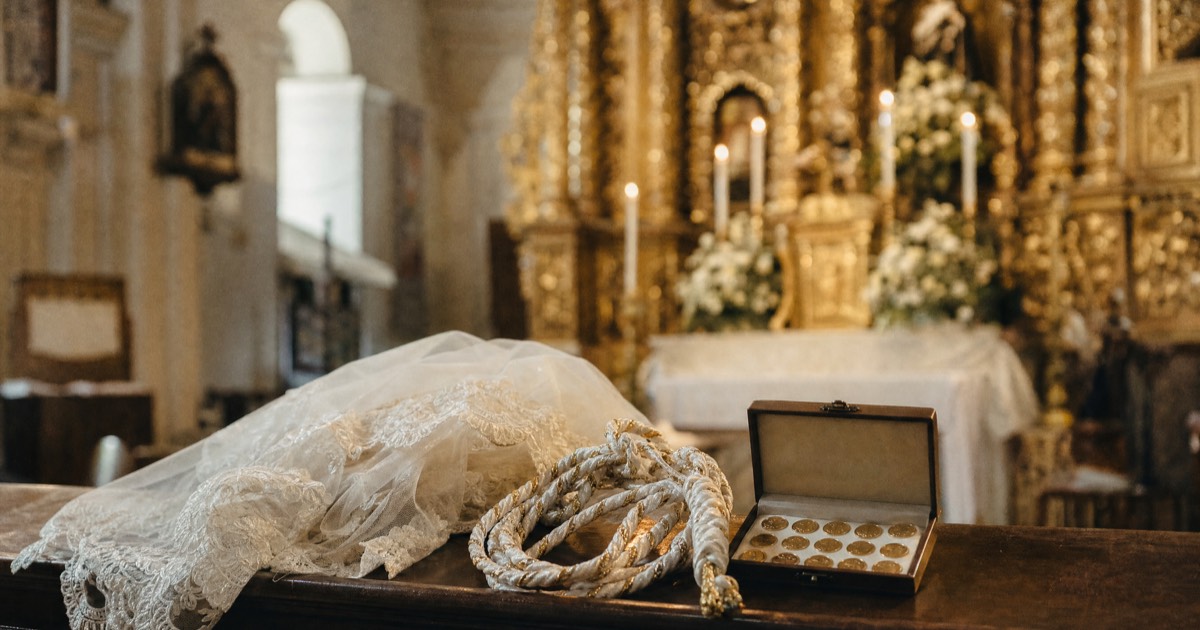
- Veil sponsors drape a light veil over the couple, usually across their shoulders.
- Cord sponsors lay the cord (yugal), shaped like a figure eight, over the veil.
Event Nest, a Philippine wedding site, describes the veil as "symbolizing shelter and shared life" and the candle as "light for the home." The cord's figure eight stands for the bond that ties the couple together.
Where do they happen in the Mass? Less fixed than most guides say. The US bishops' outline of the wedding Mass places the optional "Blessing and Placing of the Lazo or the Veil" after the Lord's Prayer and before the Nuptial Blessing, and notes it "could also be done before the Lord's Prayer, or even earlier, according to local custom." That outline calls the rite "important in Hispanic and Filipino families." It has no step for candles at all. Event Nest says the candle "varies by tradition."
So the order the sponsors walk in, and the moment each rite happens, is your parish's call. Ask the church coordinator, then use that order in your program and in the processional.
Pick secondary sponsors who are comfortable in front of a crowd. They walk to the altar, handle a veil or a cord with pins, and step back on cue. Siblings, cousins and barkada who are already married often fit. Your lola is better honored as a principal sponsor. Our secondary sponsors guide covers who places the veil and cord, how to ask, and what each pair wears.
How do you list principal sponsors on the wedding invitation?
This is where most couples first type the list, so get it right once. The common layout:
Parents of the Bride · Parents of the Groom
Principal Sponsors
Mr. Ramon Delgado · Mrs. Ana Maria Delgado
Mr. Federico Alvarez · Mrs. Corazon AlvarezSecondary Sponsors
Candle · [name] and [name]
Veil · [name] and [name]
Cord · [name] and [name]
(Sample names, not real sponsors.)
Three rules keep it clean:
- Pair each ninong with his ninang on one line, in two columns.
- Decide on titles once. Either every sponsor gets "Atty.", "Dr." or "Engr.", or nobody does.
- Send each sponsor their line to check before anything goes to print. "Ninang, paki-check po ng spelling ng name n'yo." Sponsors notice their own names first.
For the full order of the entourage, from parents to bearers, see the entourage list guide.
How do you ask someone to be your ninong or ninang?
Ask before their name goes on anything. Traditionally that means in person, over a meal or a visit. The Smile Bar suggests sounding sponsors out informally first, by text or chat, then sending a formal card once they've agreed. Read the relationship. A tito who taught you to drive gets a visit.
Keep the ask short and name the role:
Tita, kayo po ang gusto naming maging ninang sa kasal namin. Papayag po ba kayo?
For a secondary sponsor, say which rite. "Be a sponsor" means nothing to most people outside wedding planning, and a cousin who learns at rehearsal that she's pinning a veil in front of 200 guests won't enjoy the surprise.
How early? There's no official lead time, but the attire sets one. Event Nest's entourage attire timeline has couples settle the colour palette at least five months out and book dressmakers four months out. A ninang having a gown made needs to know before that.
If someone says no, thank them, don't press, and leave the slot empty rather than fill it with someone you asked out of duty.
What do principal sponsors wear?
Event Nest describes the ninong in a barong Tagalog, "worn untucked over a plain white undershirt and black trousers," and the ninang in a Filipiniana like the baro't saya or a formal gown in "silk, chiffon, or lace." Secondary sponsors dress a step down: "If your ninangs wear floor-length gowns, your secondary sponsors can wear tea-length or midi dresses."
If you have a motif, give the ninangs a colour near it but not in it, so they don't read as bridesmaids in photos. Our sage green and emerald green guides show how that works by role. Send your sponsors the colour with a photo swatch, in a personal message, after they've said yes.
Gifts, going both ways
Sponsors usually give the couple a gift, often cash, and many families expect it to be more than a regular guest's. Nobody publishes a standard amount, and it varies by family and region. Don't choose a ninong for the size of his envelope; you're asking him to mentor your marriage for years.
Your side: their name on the invitation, a seat of honor and a thank-you. Many couples give principal sponsors a separate souvenir from the one guests take home. Our wedding souvenirs guide has ideas for the sponsors' table.
Can you have sponsors in a civil wedding?
Yes. A civil wedding still needs two witnesses of legal age, and many couples ask a ninong and ninang to be them. The civil wedding invitation sample shows how to list them, or to head the list "Witnesses" when they're a sibling and a best friend. Candle, veil and cord sponsors come from church practice, so most civil weddings leave them out. Nothing stops you from keeping them at a garden ceremony if the officiant agrees.
Keeping the sponsor list in one place
Ceremo's invitation website has an entourage section, free on every plan, with Principal Sponsors, Candle, Veil and Cord Sponsors among its starting roles. Sponsors can be paired side by side in two columns, so your ninang sees her name and her pairing before you print anything. The attire guide, also free, holds up to six roles with two photos each, so "ninang" can have its own colour and example. Sponsors who are guests get the same household RSVP link as everyone else, and the seating planner puts them at the sponsors' table.
If you only need the list on a printed program, a Canva template does that fine. If you want sponsors to check their own names and RSVP from one link, Ceremo is free for up to 50 guests, and Premium is a one-time ₱2,499 for a bigger list. Start your wedding website and put the sponsors' names up where they can check them first.
Frequently asked questions
What are principal sponsors in a wedding?
Principal sponsors are the ninong and ninang of a Filipino wedding: married couples or respected elders who witness the vows, often sign the marriage certificate and stay on as the couple's mentors. They walk in pairs in the processional and sit in the place of honor at the reception.
How many principal sponsors can you have?
The law needs only two witnesses of legal age. Past that, the parish decides: the Manila Cathedral allows up to eight pairs of sponsors, and other churches set their own cap. Many couples ask two to four pairs for a small wedding and six to eight for a large one.
What is the difference between principal and secondary sponsors?
Principal sponsors (ninong and ninang) are the honored witnesses and mentors of the marriage. Secondary sponsors are the candle, veil and cord pairs who carry out one symbolic rite during the ceremony. Secondary sponsors are usually younger relatives or friends.
What do principal sponsors wear?
The ninong usually wears a barong Tagalog over a white undershirt with dark trousers. The ninang wears a Filipiniana such as a baro't saya, or a formal gown. Couples with a motif usually give the ninangs a colour one step away from the bridesmaids.
Do civil weddings have principal sponsors?
They can. The Family Code asks for at least two witnesses of legal age, and many couples ask a ninong and ninang to be those witnesses. Candle, veil and cord sponsors come from church practice, so most civil weddings skip them.
How do you list principal sponsors on a wedding invitation?
Put them after the parents under the heading Principal Sponsors, or Mga Ninong at Ninang for a Tagalog card, in two columns with each ninong beside his ninang. Use each name exactly as the sponsor writes it, and decide on titles like Atty. or Dr. once for everyone.